

Christmas is a time of joy, gathering with loved ones and giving each other gifts. In this era of mass production, handmade gifts that show that someone has put their heart and time into preparing something special are gaining more and more value.
One such special gesture is handmade Christmas cards. They add a personal touch and allow you to express your creativity, while providing a great opportunity to relax with creative work.
Handmade Christmas cards do not have to be complicated or time-consuming. With just a few basic materials and a little imagination, you can create small works of art that are sure to please your gift recipients.
In this article, we will present 10 creative ideas for simple DIY Christmas cards that anyone can make at home.
Advantages of handmade cards
Handmade Christmas cards have many advantages that make it worthwhile to take the time to create them:
- Personalization and uniqueness
- A handmade card is unique and unrepeatable, which gives it a personal touch. You can customize the designs, colors and content to the recipient, which makes such a gift more personal and special.
- An expression of emotion and commitment
- Making a card with our own hands is a sign that we put our heart and time into it. Such a gesture shows that we remember the other person and want to make them happy in a special way.
- Saving Money
- Creating DIY cards can be a cheaper alternative to ready-made products available in stores, especially if you use materials you already have at home, such as leftover paper, ribbons or ornaments.
- Ecological approach
- By making cards ourselves, we can use recycled or eco-friendly materials, thus reducing the negative impact on the environment. We can also create cards without unnecessary packaging and plastic.
- Development of creativity and manual skills
- Creating DIY cards is a great opportunity to develop your artistic skills, imagination and manual skills. It can also be a way to relax and unwind while doing creative work.
- Ability to involve loved ones
- Making cards is also a great opportunity to spend time with family or friends. Creating Christmas ornaments together can become a tradition that will bring loved ones together and set a festive mood.
With these advantages, handmade Christmas cards become not only a beautiful gift, but also a valuable creative and emotional experience.
Materials and tools needed
You don’t need complicated tools or expensive materials to create simple DIY Christmas cards. Here are the basic things that can come in handy:
- Paper and cardboard
- Base cardstock: It is best to use thicker cardstock (at least 200 gsm) to form the base of the card. You can choose classic white cardstock or colored cardstock, depending on your preference.
- Decorative paper: This can be scrapbooking paper, colored paper, Christmas-themed paper or even leftover gift wrapping paper.
- Scissors and paper cutter
- Scissors: For cutting simple shapes and trimming paper to size.
- Paper cutter: Useful for precise cutting of more complicated patterns.
- Glue
- Glue stick: For joining paper pieces.
- Hot glue: Ideal for attaching heavier decorations such as ribbons, buttons or 3D ornaments.
- Double-sided tape: can be used to create spatial elements or attach decorative paper.
- Decorations
- Ribbons, lace, buttons, sequins: They add elegance and charm to the cards.
- Stamps and inks: Allow you to quickly and effectively add festive designs, such as snowflakes, stars and reindeer.
- Stickers: Christmas stickers can be an easy way to decorate a card.
- Markers, pens and paints
- Markers and pens: For drawing patterns or adding inscriptions, such as Christmas wishes.
- Watercolor or acrylic paints: For painting backgrounds or striking decorations.
- Decorative punches
- Punches in the shape of stars, hearts, snowflakes, etc. add interesting elements to a card without much effort.
- Glitter and glitter glue
- Great for adding a festive flair and special touch.
- Twigs, dried flowers, pinecones
- Natural elements can be an original addition to the card, emphasizing its unique character.
- Ruler and pencil
- Useful for measuring, drawing straight lines and preliminary sketching of patterns.
These basic materials and tools are enough to create a variety of Christmas card designs, allowing you to fully exercise your own creativity and customize your designs.
10 creative DIY Christmas card ideas
Cutout card
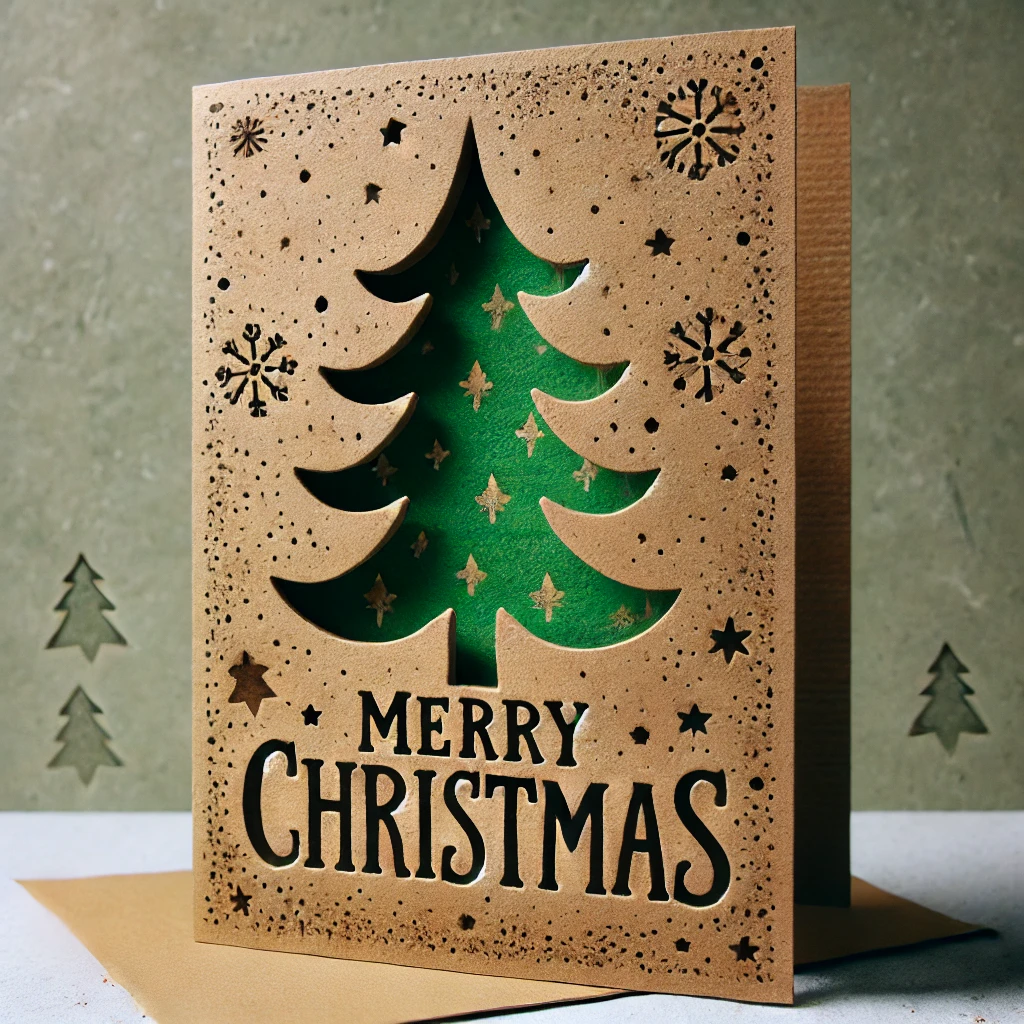
A Christmas card with cut-out patterns is a great way to create a striking, yet simple to make decoration. Cut-out patterns can add a three-dimensional touch to the card and give it an artistic look.
Method of implementation:
- Preparing the base of the card
- Choose thick cardboard (at least 200 gsm) in any color and cut out a rectangle that, when folded, will be the right size, such as A6 or A5.
- Fold the cardboard in half, forming a card base.
- Choosing a pattern to cut out
- You can prepare a pattern template or print a ready-made design from the Internet. Possible patterns to cut out include:
- Christmas tree – a classic holiday motif, which can be cut in different variations, such as with decorations on the branches.
- Snowflake – adds softness and winter atmosphere to the card.
- Star – a symbol of Christmas, which can be in different shapes.
- Reindeer – a great theme for children’s cards.
- Snowman– simple to cut out, ideal for beginners.
- Bombs – can be placed several side by side or as hung on a drawn line.
- You can prepare a pattern template or print a ready-made design from the Internet. Possible patterns to cut out include:
- Pattern cutting
- Place the template on the front of the card and outline the design with a pencil. Then use a paper cutter or precision scissors to carefully cut out the outline.
- If you want a three-dimensional effect, leave some pieces partially attached to the card so that they can be gently bent outward.
- Additional decorations
- After cutting out the design, you can add a decorative background inside the card, such as colored paper, glitter or glitter foil to make the cut-out design stand out more.
- Stamps, stickers, drawings or handwritten wishes can be added around the cut-out design.
- Emphasize the notch effect
- You can outline the edges of the design with a thin pen in a contrasting color to make the cutout more visible.
- Add elements such as ribbons, beads or sequins to enhance the decoration.
Possible patterns to be cut out:
- Traditional motives: Christmas tree, star of Bethlehem, bauble, angel, snowflake.
- Animals: reindeer, birds on a twig, Christmas bear.
- Christmas symbols: bell, candle, nativity scene, Santa Claus.
- Geometric patterns: stars, circles, lines arranged in a Christmas tree or snowman.
A cutout card is a great way to show off your creativity and create a unique holiday gift for loved ones.
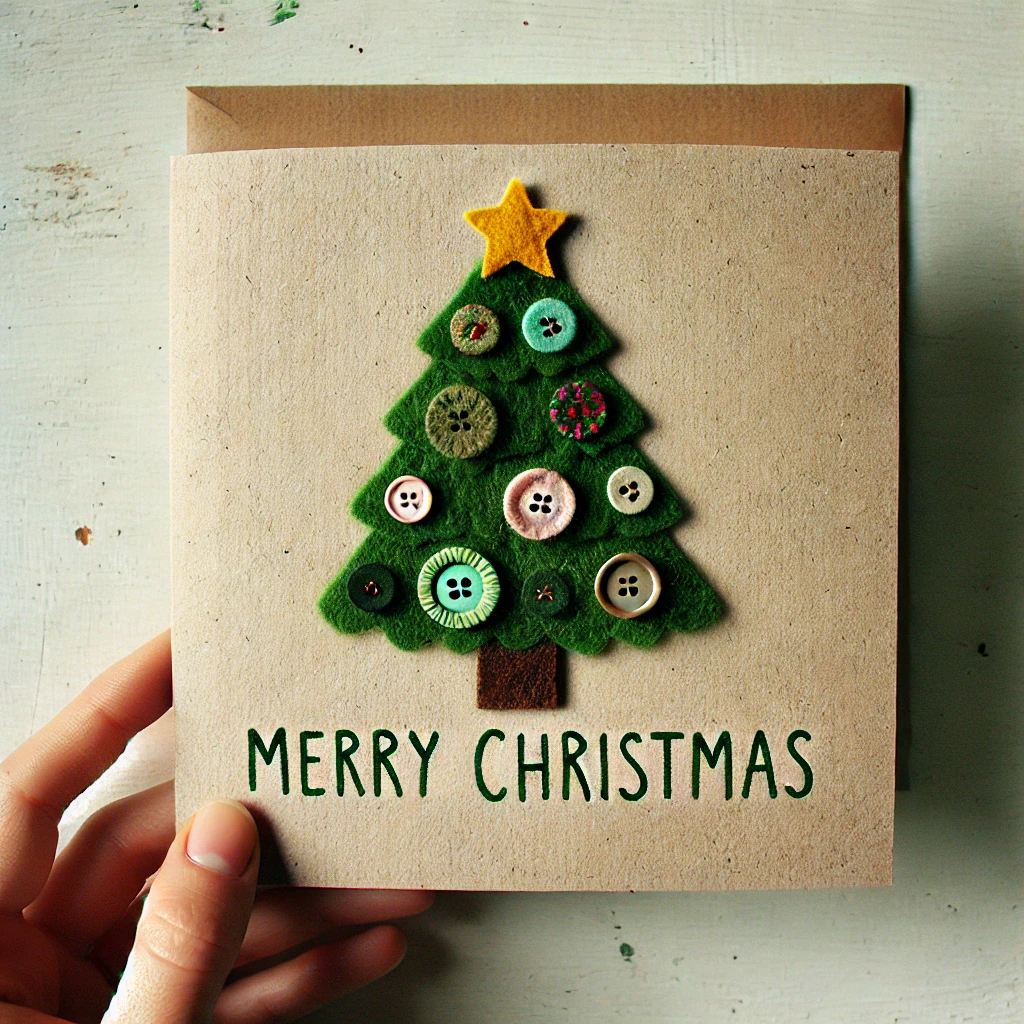
A Christmas card with a Christmas tree motif is a classic and beautiful way to bring in the holiday spirit. Making it out of felt or paper adds texture to the card and makes it more visually interesting.
Card with Christmas tree motif made of felt or paper
Method of implementation:
- Preparing the base of the card
- Choose a cardboard of at least 200 gsm to be the base of the card. It can be green, red, white or any other color that matches the holiday theme.
- Cut out a rectangle of cardboard, which when folded will be A6 or A5 in size. Fold the cardboard in half, creating a card base.
- Choosing a Christmas tree material
- Felt: Choose green felt to create a Christmas tree. You can use different shades of green to add depth.
- Paper: Choose colorful origami paper, decorative paper or even newspapers that you can paint green.
- Cutting out the Christmas tree
- Cut out a Christmas tree shape from felt or paper. It can be a simple triangle, a more complicated pattern with branches or a stylized Christmas tree in the form of a spiral.
- You can also create several layers of a Christmas tree by cutting out pieces of different sizes and gluing them on top of each other to create a 3D effect.
- Gluing the Christmas tree to the card
- Use hot glue or glue stick to attach the Christmas tree to the front of the card. If you use felt, hot glue will hold better.
- Place the Christmas tree centrally or with a slight offset to give the card a unique touch.
- Decorating the Christmas tree
- Add ornaments such as small buttons, sequins, beads or mini baubles to mimic decorations on a Christmas tree.
- You can also add ribbons, string or pieces of fabric as garlands.
- On the top of the Christmas tree, glue a small star cut from paper, felt or made from glitter.
- Additional card decorations
- Around the Christmas tree you can add small drawings, stamps or stickers in the shape of snowflakes, stars or presents.
- Add handwritten Christmas wishes at the bottom of the card or inside.
- Emphasize the texture effect
- If you use felt, you can slightly curve the edges of the Christmas tree to add spatiality.
- For paper, you can gently trim the edges to make them look ragged, which will give the card a rustic style.
Such a Christmas card with a Christmas tree motif will not only be a beautiful decoration, but also a unique gift that is sure to please anyone who receives it.
Minimalist card with hand-painted snowballs
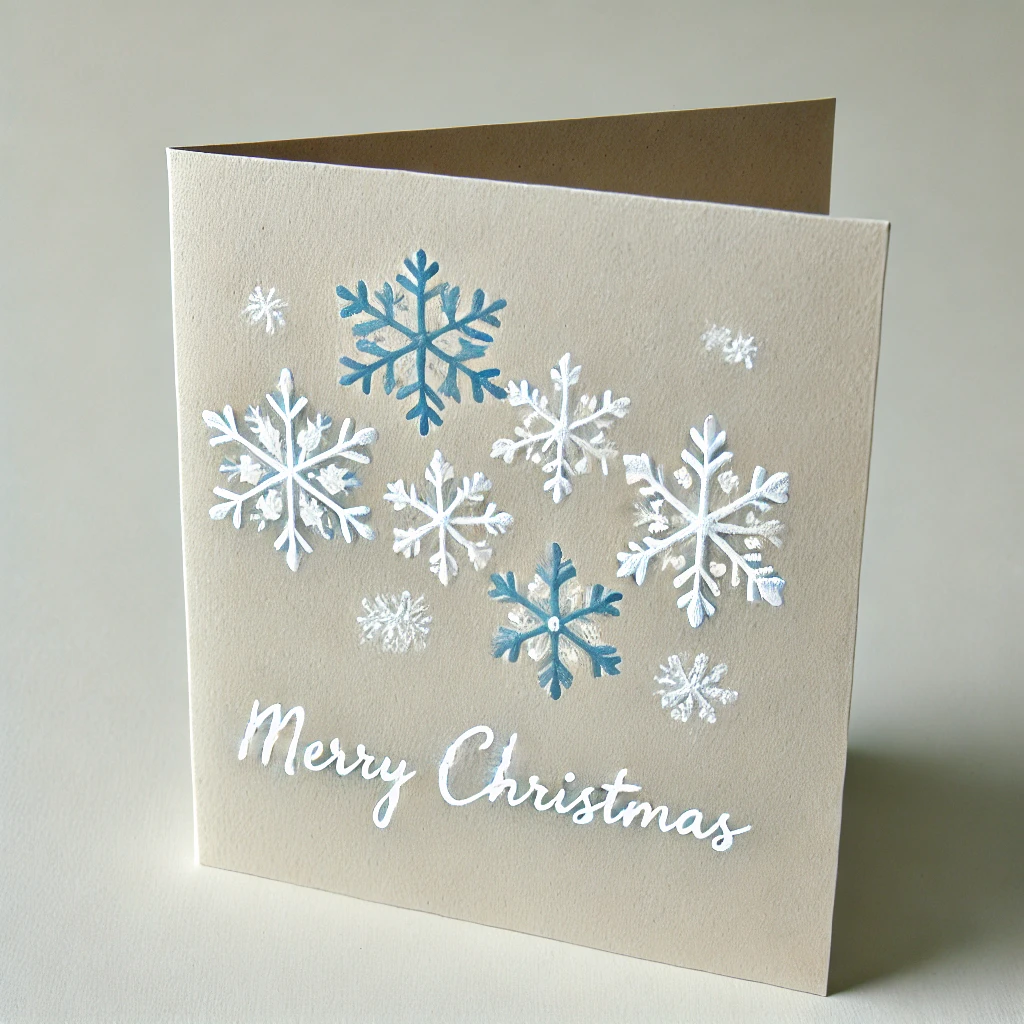
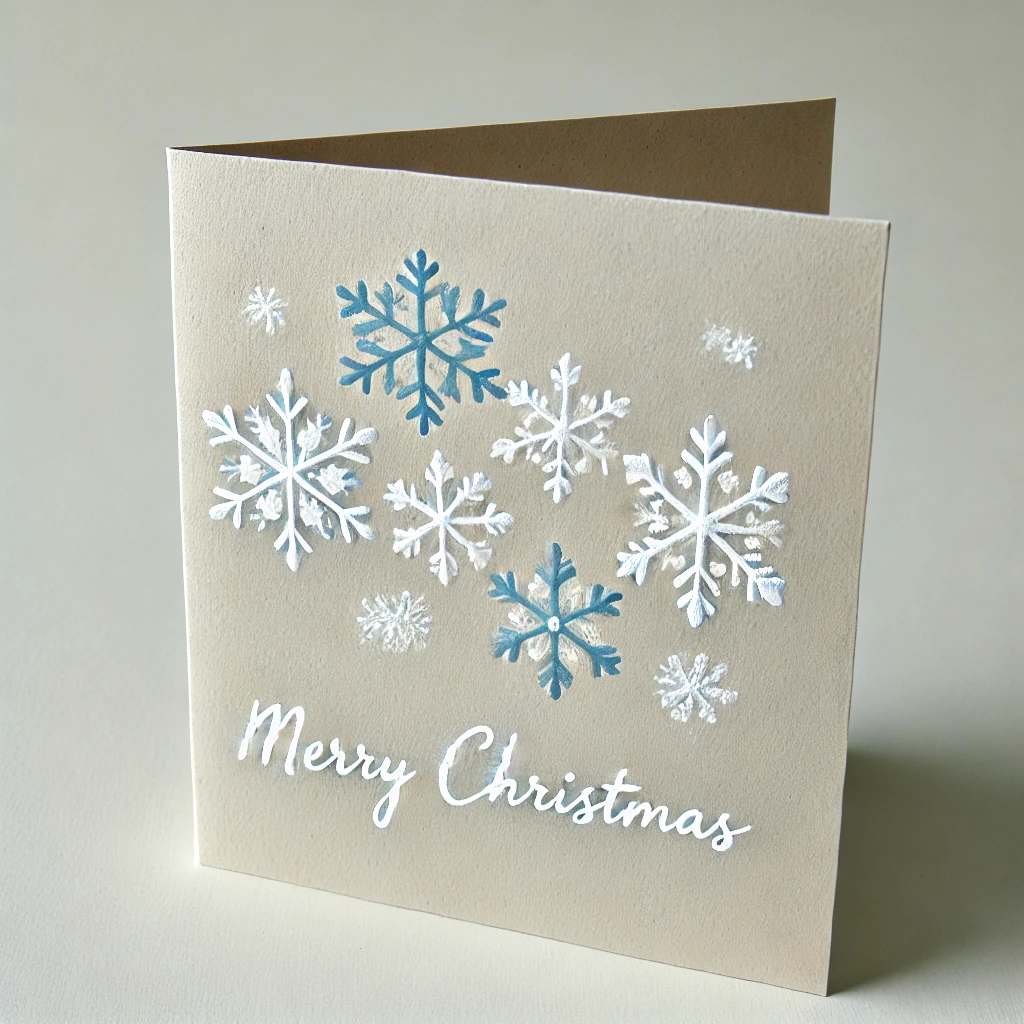
Christmas card with a motif of hand-painted snowflakes is ideal for those who appreciate simplicity and elegance. The minimalist design makes the card subtle, but at the same time eye-catching with its delicacy.
Method of implementation:
- Preparing the base of the card
- Choose white cardstock of at least 200 gsm to serve as the base of the card. Cut it to the appropriate size, such as A6, and fold it in half to create a simple card form.
- Painting snowflakes
- Prepare acrylic or watercolor paints in white and light blue. Using a thin brush, paint snowballs on the front of the card. The snowballs can be of different sizes, and their lines can be gently uneven to add a natural look.
- Try to arrange the snowballs randomly, which will give the card a light and dynamic effect.
- Adding subtitles
- At the bottom of the card, you can handwrite holiday greetings such as “Merry Christmas” or “Happy Holidays.” Choose a simple, casual handwriting style to match the minimalist nature of the card.
- Optional extras
- If you want to add a little more depth to the card, you can lightly dust the wet paints with glitter or add some small hand-drawn dots around the snowflakes to mimic falling snow.
- Emphasize minimalism
- Leave the background of the card blank to focus attention on the painted snowballs. This simple approach makes for an elegant and aesthetically pleasing card.
Minimalist Christmas card with hand-painted snowballs is a great choice for lovers of modest but sophisticated decorations. It is easy to make, yet looks stylish and original.
Designs that can be used on Christmas cards
Decorative designs on Christmas cards give them a unique character and help create a festive atmosphere. Depending on the style, you can choose classic, minimalist or more richly decorated motifs. Here are some suggestions for designs that can be used:
Christmas themes
- Christmas trees
- The classic Christmas tree is one of the most popular motifs. They can be cut out of paper, made of felt, painted or created from pine branches. Christmas trees can be simple, stylized, consist of triangles, spirals or be richly decorated with baubles and stars.
- Stars and snowflakes
- Stars can be easily cut out or drawn, and snowflakes can be hand-painted or stamped. These are subtle winter designs that add elegance to the cards. You can use different shades of white, blue and even silver for an interesting effect.
- Reindeer and Santa Claus
- Perfect for children’s cards or for those who appreciate fun motifs. Reindeer can be cut out of paper or drawn, and Santa Claus can be painted or depicted with simple symbols, such as a red hat with a pom-pom.
- Christmas baubles
- They can be cut out of paper, painted or made of felt. They can decorate a card as a hanging garland or individually, adding a colorful touch.
- Candles and lanterns
- The motif of candles and lanterns adds a warm, festive mood. You can paint them or make them out of paper, or even use materials such as ribbons to add a realistic effect.
Geometric patterns
- Straight lines and shapes
- Instead of traditional motifs, straight lines, triangles, circles or squares can be used to arrange themselves into festive patterns, such as a Christmas tree made of triangles or snowballs made of circles.
- Abstract patterns
- Unusual asymmetrical patterns or irregular shapes can give a card a modern touch.
Natural elements
- Twigs, pinecones, dried flowers
- You can use real pine branches, dried flowers or pinecones to add a natural, rustic flair to the card.
- Leaves of holly or mistletoe
- Perfect for adding a festive touch. You can paint them, cut them out of paper or use artificial decorations.
Minimalist vs. richly decorated designs
- Minimalist designs: Simple lines, subtle drawings or small accents that do not dominate the card. Great for those who appreciate elegant and modern style.
- Richly decorated designs: Include detailed illustrations, layered cutouts, large ornaments or the use of various techniques such as embossing (stamping). They can be more colorful and detailed, creating striking holiday compositions.
Tips for combining patterns
- Combine motifs in a similar style (e.g., geometric patterns with minimalist ones) for consistency.
- Avoid an excess of different designs on a single sheet of paper so as not to overwhelm the recipient.
- Use the background as a supporting element for the designs – for example, solid colors that enhance the main theme.
The choice of designs depends on the individual preferences and style of the person who creates the card. Regardless of the choice, it is important that the card is made with heart and brings joy to both the creator and the recipient.